Understanding Alien Plant Invasions

Alien plants are everywhere โ€“ but not all invaders behave the same

a group of yellow flowers
Photo by Brittany Lee on Unsplash

Alien plant invasions are accelerating worldwide, posing serious threats to biodiversity and costing billions in management. A recent study โ€“ led by David Gregory as part of his Masters at King’s and in collaboration with Matt White from the Victorian government โ€“ sheds light on how these invasions unfold across landscapes and why growth form matters when predicting and managing risk.

The research, conducted in Victoria, Australia, analysed data from more than 7,600 vegetation surveys spanning five decades. It found that 69 per cent of surveyed plots contained alien species, which made up 22 per cent of all recorded plant species. Forbs (broad-leaved herbs) were the most common invaders, followed by graminoids (grasses and similar) and woody plants. Yet the patterns of invasion were far from uniform.

Using boosted regression trees โ€“ a machine-learning approach well suited to ecological data โ€“ the team modelled how environmental, biotic and human factors influence both the presence and dominance of alien plants. Abiotic conditions, particularly temperature and rainfall, emerged as the strongest drivers overall, explaining up to 76 per cent of variation in invasion risk. Summer maximum temperature was a consistent predictor across all growth forms, with occupancy rising sharply above 23ยฐC.

Human activity also played a major role. Areas with intensive land use, such as urban centres and agricultural zones, showed the highest levels of invasion. Alien forbs and graminoids were especially prevalent in these disturbed landscapes, often reaching more than 70 per cent cover in towns and cities. Alien woody plants were less widespread but still more likely to occur in urban areas than in intact forests.

Interestingly, the relationship between vegetation cover and invasion differed by growth form. Alien forbs and graminoids were more likely to occupy sites with high vegetation cover, but their proportional cover tended to decline as native vegetation increased โ€“ a sign of strong competition. Woody invaders, by contrast, were negatively associated with woody vegetation cover, suggesting that dense tree cover offers resistance to colonisation.

Spatial predictions confirmed these trends. Alien forbs had a high probability of occurring almost everywhere, even at higher elevations, though their cover remained low in alpine regions. Alien graminoids were largely confined to lowland areas dominated by human activity, while woody invaders were the most restricted, reflecting lower seed dispersal and availability and lower habitat suitability.

A global challenge


These findings resonate far beyond Australia. Invasive alien plants are among the top five drivers of biodiversity loss globally, according to the Intergovernmental Science-Policy Platform on Biodiversity and Ecosystem Services (IPBES).

They disrupt ecosystems, alter fire regimes and threaten food security. Economic costs are staggering โ€“ estimated at more than US$400 billion annually worldwide โ€“ and rising as trade and travel expand. Climate change compounds the problem by creating conditions that favour invaders, while land-use change accelerates their spread.

Understanding invasion dynamics at scale is therefore critical for global conservation strategies.

The implications for management are clear. Maintaining and restoring native vegetation is critical to limiting alien plant dominance, particularly after disturbances such as wildfire โ€“ a growing risk under climate change. Urban expansion and agricultural intensification will likely increase invasion pressure, making strategic land-use planning essential. Grouping species by growth form, as this study does, offers a practical way to prioritise control efforts without building hundreds of single-species models.

Alien plant invasions are complex, shaped by climate, land use and ecological interactions. But by recognising both shared drivers and growth-form-specific patterns, we can design more effective strategies to protect ecosystems. Growth-form-based models provide a tractable, widely understood tool for science and policy โ€“ a step towards smarter, landscape-scale management of one of the most pressing environmental challenges of our time.

Read more:

Gregory D, White M, Catford JA (2025) Similar drivers but distinct patterns of woody and herbaceous alien plant invasion. NeoBiota 103 31โ€“52. https://doi.org/10.3897/neobiota.103.164914

Article originally posted on KCL’s Spheres of Knowledge

Species invasions and climate change: can grasslands cope?

Lizzie Jones and I contributed a chapter about grassland invasions toย Grasslands and Climate Change, the latest volume of the British Ecological Society’sย Ecological Reviewsย series. This is a blog post that Lizzie โ€“ a former MSc student of mine at Southampton โ€“ and I wrote for the Journal of Ecology blog.

Imagine a typical grassland ecosystem. You might see American prairies, rangelands of Australia, or African savannah. Either way, youโ€™re probably thinking of wide-open spaces, dominated by resilient grass-like species. Yet, despite covering over 35% of the ice-free land surface, grasslands are an increasingly fragile ecosystem, experiencing some of the highest levels of exotic plant species invasion of all ecosystems. While there are strong links between levels of grassland invasion and human activity (as work by the Nutrient Network shows), climate change is also thought to be a key driver of such invasions.

ยฉ Getty Images

It is well established that there will be both winners and losers with climate change, where some species experience increases in range and population sizes, while other experience reductions. A key prediction nevertheless remains that exotic species invasion will increase with climate change, especially with rises in temperature and increases in extreme climatic events. Given that โ€“ like native species โ€“ individual exotic species can be helped or hindered by climate change, why does this remain a general prediction? It makes sense that some species will benefit from changes in climate regimes, and others will not, but why should some species experience an advantage simply because they are non-native?

In our chapter of Grasslands and Climate Change, we address these questions by concentrating on the effects of climate change on exotic plant invasion in global grasslands. We specifically ask whether climate change will favour exotic species, why that might be the case, and what sort of species (including their functional traits) will be favoured. In the chapter we used a systematic approach to review three key environmental changes that may give advantage to invasive species: changes in background climate conditions including temperature and rainfall; increased disturbance from extreme events such as storms and droughts; and human responses to climate change, either to mitigate its effects or to adapt to them.

2
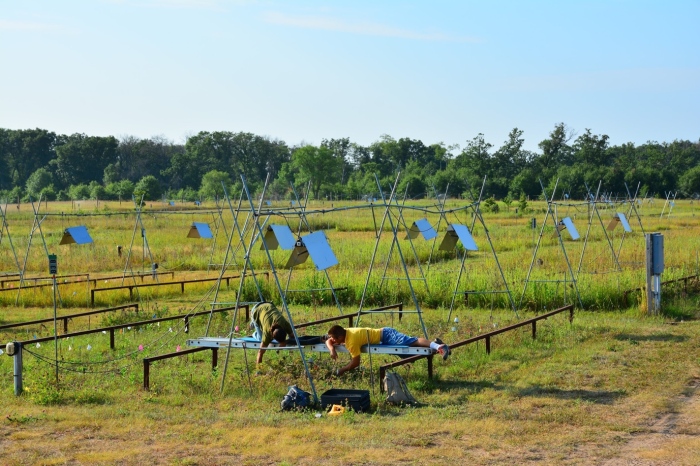
A warming and biodiversity grassland experiment at Cedar Creek Ecosystem Science Reserve: experiments like these provide insights into the impact of climate change, including species invasions. Photo by Jacob Miller.

Exotic species are well-adapted to capitalise upon change โ€“ their very invasion shows that that they are able to expand their distributions and deal with what might be unfamiliar ecological conditions. Increases in the frequency and magnitude of storm events, floods, fires and other disturbances will increase opportunities for invasion, and species that can reproduce and spread quickly will be particularly well placed. For example, some Bromus grasses can recover very rapidly when drought eases, which has allowed them to invade and convert woody scrubland areas in North America. The ability to seize opportunities and cope with a broad range of environmental conditions means that climate change will favour many exotic species โ€“ especially compared with native species, which may be less able to keep pace with changing conditions.

3

Finally, humans have a huge impact on grassland invasion. In our efforts to mitigate, offset and adapt to our changing climate, we are unwittingly exacerbating the invasion of exotic species globally. A key culprit is the production of biofuel, such as Miscanthus species, now widely used in North America and Asia and predicted to spread with climate change.

So, to respond to the question โ€œcan grasslands cope with species invasions and climate change?โ€ โ€“ native grassland species are certainly under threat not only by exotic species but by a multitude of human and climate-related issues. But, as this book shows, work towards adapting current conservation and management strategies is already underway to keep pace with our changing climate, not only in grasslands but in all other ecosystem types.

Lizzie P. Jones (Royal Holloway, University of London and Institute of Zoology, London, UK) and Jane A. Catford (Kingโ€™s College, London, UK)


Grasslands and Climate Change is part of the Ecological Reviews series. BES members get 25% off all titles in the series when buying directly from Cambridge University Press. See also, David Gibsonโ€™s blog post: Grasslands and Climate Change.