When Scale Shapes Ecological Truths

Rethinking Darwinโ€™s Naturalisation Conundrum through Spatial Lenses
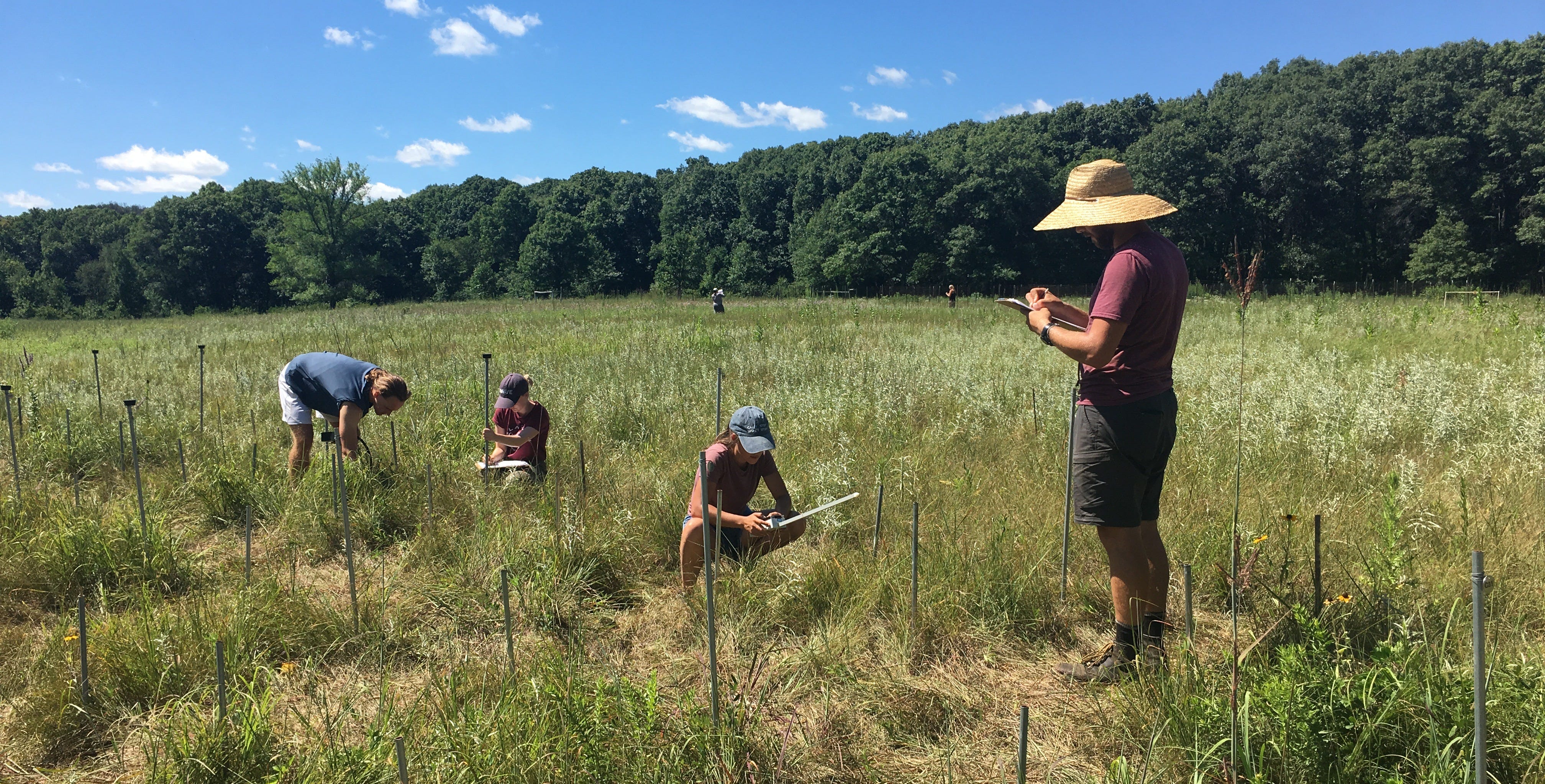
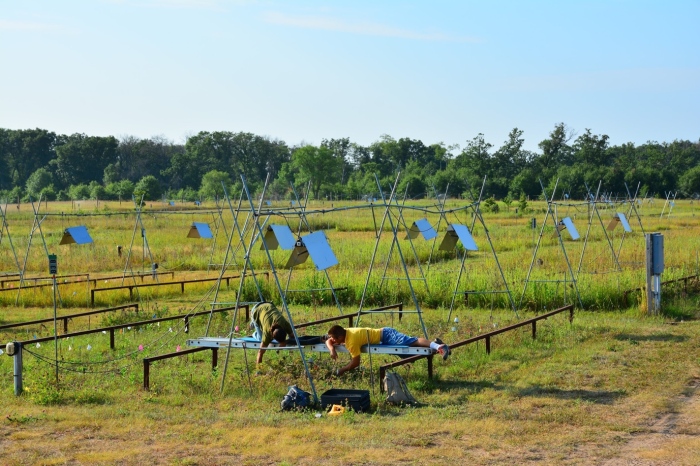
Photo: Jane Catford

Darwinโ€™s naturalisation conundrum has long puzzled ecologists. Two competing ideas – preadaptation and limiting similarity – offer contrasting explanations for why some introduced species thrive while others fail. 

The former suggests that invaders succeed when they resemble native species, benefiting from shared traits suited to local conditions. The latter argues that similarity breeds competition, so success favours difference. Both sound plausible, yet evidence has remained inconsistent.

A recent study led by Maria Perez-Navarro and colleagues at Kingโ€™s College London sheds light on why. The team examined 33 years of grassland succession data in Minnesota, testing these hypotheses at two unusually fine spatial scales: neighbourhood plots of 0.5 mยฒ and site transects of 40 mยฒ. This methodological choice proved decisive.

At the neighbourhood scale, where plants interact directly, practical features such as height and leaf structure mattered most. Species that differed in these traits were more abundant, supporting the limiting similarity hypothesis. Competition, it seems, rewards difference. Yet at the larger site scale, environmental filtering dominated. Here, species more similar to the community – those sharing traits suited to local conditions – were favoured, aligning with preadaptation.

Intriguingly, evolutionary closeness told a different story. Introduced species that were close to natives in the โ€œfamily treeโ€ thrived at both scales, reinforcing preadaptation even where trait-based analyses suggested otherwise. This disconnect between evolutionary lineage and physical features highlights a key insight: these two measures are not interchangeable.

The study also revealed nuanced differences between native and introduced species. Introduced plants tended to prosper with lighter seeds, higher leaf dry matter content, and in nitrogen-rich soils, suggesting distinct strategies for colonisation and resource use.

What does this mean for invasion ecology? First, spatial scale matters – profoundly. Analyses at tens of metres, often deemed โ€œlocalโ€, may obscure competitive dynamics evident only at sub-metre scales. Second, relying on a single measure of similarity risks misleading conclusions. Evolutionary relationships and practical traits capture different dimensions of ecological reality.

Beyond its technical findings, this research invites reflection on how ecological theory grapples with complexity. Darwinโ€™s conundrum endures not because the underlying hypotheses are flawed, but because nature resists simple binaries. Community assembly is shaped by overlapping forces – competition, environmental filtering, evolutionary history – whose influence shifts with scale and context.

For practitioners, the message is clear: management strategies for invasive species must consider both the traits that confer advantage and the environments that filter them. For theorists, the challenge remains to integrate these insights into models that embrace, rather than flatten, ecological nuance.

In the end, the study reminds us that scale is not a backdrop but an active player in ecological processes. To understand why species succeed or fail, we must look closely – sometimes as closely as half a square metre.

Read more:

Perez-Navarro, Maria A., Harry E. R. Shepherd, Joshua I. Brian, Adam T. Clark, and Jane A. Catford. 2025. โ€œ Evidence for Environmental Filtering and Limiting Similarity Depends on Spatial Scale and Dissimilarity Metrics.โ€ Ecology 106(11): e70244. https://doi.org/10.1002/ecy.70244

Article originally posted on KCL’s Spheres of Knowledge

Species invasions and climate change: can grasslands cope?

Lizzie Jones and I contributed a chapter about grassland invasions toย Grasslands and Climate Change, the latest volume of the British Ecological Society’sย Ecological Reviewsย series. This is a blog post that Lizzie โ€“ a former MSc student of mine at Southampton โ€“ and I wrote for the Journal of Ecology blog.

Imagine a typical grassland ecosystem. You might see American prairies, rangelands of Australia, or African savannah. Either way, youโ€™re probably thinking of wide-open spaces, dominated by resilient grass-like species. Yet, despite covering over 35% of the ice-free land surface, grasslands are an increasingly fragile ecosystem, experiencing some of the highest levels of exotic plant species invasion of all ecosystems. While there are strong links between levels of grassland invasion and human activity (as work by the Nutrient Network shows), climate change is also thought to be a key driver of such invasions.

ยฉ Getty Images

It is well established that there will be both winners and losers with climate change, where some species experience increases in range and population sizes, while other experience reductions. A key prediction nevertheless remains that exotic species invasion will increase with climate change, especially with rises in temperature and increases in extreme climatic events. Given that โ€“ like native species โ€“ individual exotic species can be helped or hindered by climate change, why does this remain a general prediction? It makes sense that some species will benefit from changes in climate regimes, and others will not, but why should some species experience an advantage simply because they are non-native?

In our chapter of Grasslands and Climate Change, we address these questions by concentrating on the effects of climate change on exotic plant invasion in global grasslands. We specifically ask whether climate change will favour exotic species, why that might be the case, and what sort of species (including their functional traits) will be favoured. In the chapter we used a systematic approach to review three key environmental changes that may give advantage to invasive species: changes in background climate conditions including temperature and rainfall; increased disturbance from extreme events such as storms and droughts; and human responses to climate change, either to mitigate its effects or to adapt to them.

2
A warming and biodiversity grassland experiment at Cedar Creek Ecosystem Science Reserve: experiments like these provide insights into the impact of climate change, including species invasions. Photo by Jacob Miller.

Exotic species are well-adapted to capitalise upon change โ€“ their very invasion shows that that they are able to expand their distributions and deal with what might be unfamiliar ecological conditions. Increases in the frequency and magnitude of storm events, floods, fires and other disturbances will increase opportunities for invasion, and species that can reproduce and spread quickly will be particularly well placed. For example, some Bromus grasses can recover very rapidly when drought eases, which has allowed them to invade and convert woody scrubland areas in North America. The ability to seize opportunities and cope with a broad range of environmental conditions means that climate change will favour many exotic species โ€“ especially compared with native species, which may be less able to keep pace with changing conditions.

3

Finally, humans have a huge impact on grassland invasion. In our efforts to mitigate, offset and adapt to our changing climate, we are unwittingly exacerbating the invasion of exotic species globally. A key culprit is the production of biofuel, such as Miscanthus species, now widely used in North America and Asia and predicted to spread with climate change.

So, to respond to the question โ€œcan grasslands cope with species invasions and climate change?โ€ โ€“ native grassland species are certainly under threat not only by exotic species but by a multitude of human and climate-related issues. But, as this book shows, work towards adapting current conservation and management strategies is already underway to keep pace with our changing climate, not only in grasslands but in all other ecosystem types.

Lizzie P. Jones (Royal Holloway, University of London and Institute of Zoology, London, UK) and Jane A. Catford (Kingโ€™s College, London, UK)


Grasslands and Climate Change is part of the Ecological Reviews series. BES members get 25% off all titles in the series when buying directly from Cambridge University Press. See also, David Gibsonโ€™s blog post: Grasslands and Climate Change.