Understanding Alien Plant Invasions

Alien plants are everywhere – but not all invaders behave the same

a group of yellow flowers
Photo by Brittany Lee on Unsplash

Alien plant invasions are accelerating worldwide, posing serious threats to biodiversity and costing billions in management. A recent study – led by David Gregory as part of his Masters at King’s and in collaboration with Matt White from the Victorian government – sheds light on how these invasions unfold across landscapes and why growth form matters when predicting and managing risk.

The research, conducted in Victoria, Australia, analysed data from more than 7,600 vegetation surveys spanning five decades. It found that 69 per cent of surveyed plots contained alien species, which made up 22 per cent of all recorded plant species. Forbs (broad-leaved herbs) were the most common invaders, followed by graminoids (grasses and similar) and woody plants. Yet the patterns of invasion were far from uniform.

Using boosted regression trees – a machine-learning approach well suited to ecological data – the team modelled how environmental, biotic and human factors influence both the presence and dominance of alien plants. Abiotic conditions, particularly temperature and rainfall, emerged as the strongest drivers overall, explaining up to 76 per cent of variation in invasion risk. Summer maximum temperature was a consistent predictor across all growth forms, with occupancy rising sharply above 23°C.

Human activity also played a major role. Areas with intensive land use, such as urban centres and agricultural zones, showed the highest levels of invasion. Alien forbs and graminoids were especially prevalent in these disturbed landscapes, often reaching more than 70 per cent cover in towns and cities. Alien woody plants were less widespread but still more likely to occur in urban areas than in intact forests.

Interestingly, the relationship between vegetation cover and invasion differed by growth form. Alien forbs and graminoids were more likely to occupy sites with high vegetation cover, but their proportional cover tended to decline as native vegetation increased – a sign of strong competition. Woody invaders, by contrast, were negatively associated with woody vegetation cover, suggesting that dense tree cover offers resistance to colonisation.

Spatial predictions confirmed these trends. Alien forbs had a high probability of occurring almost everywhere, even at higher elevations, though their cover remained low in alpine regions. Alien graminoids were largely confined to lowland areas dominated by human activity, while woody invaders were the most restricted, reflecting lower seed dispersal and availability and lower habitat suitability.

A global challenge


These findings resonate far beyond Australia. Invasive alien plants are among the top five drivers of biodiversity loss globally, according to the Intergovernmental Science-Policy Platform on Biodiversity and Ecosystem Services (IPBES).

They disrupt ecosystems, alter fire regimes and threaten food security. Economic costs are staggering – estimated at more than US$400 billion annually worldwide – and rising as trade and travel expand. Climate change compounds the problem by creating conditions that favour invaders, while land-use change accelerates their spread.

Understanding invasion dynamics at scale is therefore critical for global conservation strategies.

The implications for management are clear. Maintaining and restoring native vegetation is critical to limiting alien plant dominance, particularly after disturbances such as wildfire – a growing risk under climate change. Urban expansion and agricultural intensification will likely increase invasion pressure, making strategic land-use planning essential. Grouping species by growth form, as this study does, offers a practical way to prioritise control efforts without building hundreds of single-species models.

Alien plant invasions are complex, shaped by climate, land use and ecological interactions. But by recognising both shared drivers and growth-form-specific patterns, we can design more effective strategies to protect ecosystems. Growth-form-based models provide a tractable, widely understood tool for science and policy – a step towards smarter, landscape-scale management of one of the most pressing environmental challenges of our time.

Read more:

Gregory D, White M, Catford JA (2025) Similar drivers but distinct patterns of woody and herbaceous alien plant invasion. NeoBiota 103 31–52. https://doi.org/10.3897/neobiota.103.164914

Article originally posted on KCL’s Spheres of Knowledge

The divine glory of our nation’s capital

It may come as a shock to some people, but I am delighted to say that Canberra is now my home.

For those who aren’t so familiar with Australian snobbery, Canberra (along with our South Australian sister, (R)Adelaide) tends to get a pretty bad rap. Boring; nothing to do; weird; where are the milk bars?!

While I nod my head appreciably at the last comment (and, dare I say, groovy wine bars?!), the first few seem to come from people who a) have never been to Canberra, b) came once during primary school to visit Parliament House or c) have very poor taste.

My response to this:

  • fast, flowing mountain bike trails winding through beautiful grassy woodland all of ten minutes from Canberra’s CBD;
  • Two hours to the coast, two hours to the mountains;
  • And then there are the after work strolls with kangaroos, kookaburras, cockatoos, wallabies, rosellas…

    What I did at the weekend: Canberra to Kosciuszko by bike. Photo by Milly Brent

Clearly, I am a “nature lover” (surprising, I know) and Canberra offers “nature” in droves. As well as being great for one’s physical and mental wellbeing, this also presents some great work opportunities as the field really isn’t that far away. To illustrate, I’ll briefly introduce a couple of the field sites where some of my colleagues in the Fenner School of Environment and Society work.

Mulligans Flat–Goorooyarroo Woodland Experiment

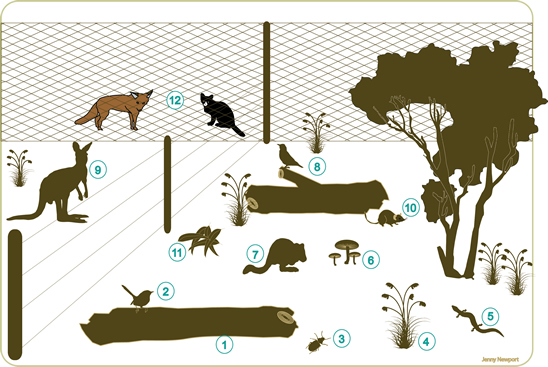
MulligansExperiment fig
Response variables being studied in the woodland experiment: 1 Dead wood; 2 Birds; 3 Invertebrates; 4 Vegetation; 5 Reptiles; 6 Fungi; 7 Bettong reintroduction; 8 Brown Treecreeper reintroduction; 9 Kangaroos; 10 Small mammals; 11 Litter, soil and soil microbes; 12 Exclusion of feral pests. See link to the left for source info.

Located in a couple of nature reserves 15 km north of central Canberra, the Mulligans Flat–Goorooyarroo Woodland Experiment is a partnership between the Australian National University, the ACT Government and CSIRO. The aim of the project is to find ways of improving box-gum grassy woodland for biodiversity and the experiment manipulates and monitors a whole raft of factors (see figure above).

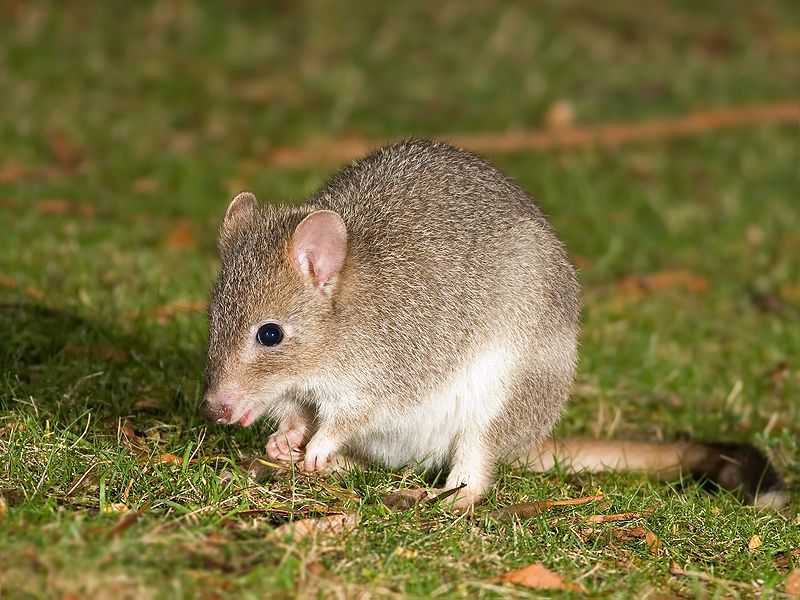
One of the many exciting aspects of this experiment is the reintroduction of the Tasmanian Bettong (Bettongia gaimardi) – it has been extinct from the mainland of Australia for 80 years.  Regarded as an ecosystem engineer, it will be interesting to learn what effects the Bettong has on the ecosystem.

Tumut Fragmentation Study

Based in the Buccleuch State Forest 100 km west of Canberra, the idea for the Tumut Fragmentation Experiment was sparked when David Lindenmayer was flying from Canberra to Melbourne. Peering out of the plane window, David saw an area of native forest that had been cleared for a radiata pine (Pinus radiata) plantation. Rather than just bulldozing the whole lot of it though, patches of native forest had been left. Representative of the original forest, these patches varied in size from half a hectare to 200 hectares thus providing a great way to study effects of forest fragmentation on biodiversity.

The Tasmanian Bettong (Bettongia gaimardi). Photo by JJ Harrison (jjharrison@facebook.com)

In all, the Conservation and Landscape Ecology group at Fenner run seven large-scale longitudinal field studies, all located in south eastern Australia. Long-term, large-scale ecological studies are pretty rare in Australia, yet provide incredibly valuable insights because many ecological processes occur at the landscape-scale, it can take a long time for ecosystems to respond to certain actions and it can also be very hard to detect ecological responses when background levels of variability are so high (just think of weather patterns versus climate change). A major impediment to establishing long-term studies is the fact that most grants last for only a few years. While there is increasing support and appreciation of long-term studies (the merits of which are nicely illustrated by the Long Term Ecological Research Network in the US), many researchers rely on passion, strong working relationships and cheap labour (i.e. their own) to maintain such research.

I have been in the Fenner School at the Australian National University for a few months now and I am just loving it. Although I am still employed by the University of Melbourne and retain strong links with the Quantitative and Applied Ecology research group, I will be based here for the duration of my grant and hopefully, fingers crossed, beyond that.

If you are ever in town, or are keen to visit, please drop me a line. We could even go to Parliament House.

Parliament House. Source: Milly Brent

Project kick-off: propagule pressure, functional traits, resource availability and plant invasion

As mentioned in a previous post, I was lucky enough to be awarded one of the inaugural ARC Discovery Early Career Researcher Awards (DECRA) late last year. I officially started my DECRA research in April, so I thought it was time that I introduce it – albeit rather briefly.

In essence, I am planning to investigate the susceptibility of native vegetation edges to alien plant invasion using quantitative and experimental approaches.  The project will contain both theoretical and applied elements and will primarily examine plant invasion through a community ecology lens (or is it community assembly through an invasion lens??!).

I’ll specifically be looking at the combined (and interactive) effects of species traits, resource availability and propagule pressure on invasion success using Bayesian meta-analysis, causal modelling and a field experiment.  As stated in my grant application, “disentangling effects of alien species’ seed supply, high resource availability (light, water, nutrients) and species’ traits on invasion will indicate their relative influence on plant invasion and community assembly.  As a result, new knowledge will be gained on the efficacy of invasive species prevention and control by indicating which invasion pathways to target, and under what conditions.”

The project will run for three years and I’ll be splitting my time between Australia and the US to achieve it. The plan is to work with CEED/NERP folk on the more quantitative aspects of the project while in Australia (principally with people like Brendan Wintle, Cindy Hauser, Mick McCarthy and Peter Vesk in the QAEcology group at Melbourne Uni, but also with Phil Gibbons and David Lindenmayer at the Australian National University; more on that later). I’ll conduct the experiment at Cedar Creek Ecosystem Science Reserve in Minnesota working with David Tilman.  I’m planning to spend two months at the University of Minnesota this year (July-August) and then 6 months for the following two years (roughly April-Sept/Oct).  As a lover of warm weather, an endless summer comes as an added bonus!